Where are your dead?
TW: Suicide
In November 2025, on an afternoon around 3:45 in Lisbon, I witnessed the suicide of a young person at the metro station in my neighborhood. It was hard to witness, hard to accept that it happened, hard to process. But do you know what was even harder? realizing that four hours later, the metro station had been cleaned and traffic was running normally again, as if nothing had ever happened. if you had passed through that station that evening, you would never have imagined that death had been there only a few hours before. No signs left behind. Nothing marking the rupture, nothing to acknowledge the life that had just left.
I thought about the boy’s family and friends and wondered how their nervous systems were supposed to adapt not only to the loss itself, but also to the speed at which the world had already moved on from it. No visible trace, no collective pause. not even the possibility to pay respect at the place where his life ended.
I have often wondered about suicide and public space, not because I believe that people who choose death necessarily want attention , as people cruelly and simplistically say, bet because there is something about many suicides that forces society to witness what it otherwise spends enormous energy tying not to see: the pain, the despair, the isolation… and what do we do afterwards? we erase the traces, we judge, we avoid talking about them, when we do it’s most of the time to make the family feel guilty, we punish them (the dead and their family) socially. So whenever there is suicide, the dead and their family disappear quickly. They are forced into silence, avoided, ostracized….
When I was living in Berlin, around my neighborhood there were 3 cemeteries. I took many walk through those cemeteries, especially on the way to kindergarten with my daughter. It was mostly there, around the cemetery, that I would see hearses entering for funerals. Coffins inside. Silence and slow movement.
The first two years, it felt familiar enough that I did not think much about it. But slowly, something started feeling strange to me. I realized that whenever I was in the city center, in crowded streets, in cool, upper class neighborhoods, I never saw hearses. Not once in six years. I only saw them near funerary homes, cemeteries, crematoriums, almost as though death itself had been geographically contained. Hidden in designated areas of the city. And that, started feeling deeply unfamiliar.
Because what I had grown up seeing at home was completely. The hearses were impossible to ignore. Family members often sat inside with the coffin and usually behind the hearses there is a convoy of many private cars of the rest of family members and friends accompanying the dead. And one thing especially: The siren on hearses, with a very specific sound. The siren would begin at the morgue and continue through the dead person’s neighborhood, through the city or the village and all the way to the cemetery.
As a child, I remember playing outside or sitting at lunch with my family when the sound of the siren suddenly passed through the street. Immediately, we knew: death was passing and not alone in a hearse but certainly with a long convoy of cars accompanying it. And almost instinctively, people would pay respect by bowing the head down or making the sign of the cross. Whether we knew the dead or not did not matter. For a brief moment, the city acknowledged the passage of a human being leaving this world, reminding us it could also be us.
That familiarity came back a little when I moved to Lisbon. Though here, hearses don’t have siren and they are neither accompanied by relatives or a long convoy of cars, so far at least I have seen more of them in Lisbon’s streets than in Berlin. There is something particular about many of them that immediately caught my attention: Most part of the back of the hearse is often made of glass, making the coffin fully visible, not just the top of it. The curtains are open, not closed to hide the coffin from the public view. You should have seen my excitement the first time I encountered one in the street, only a couple of weeks after moving here. I cried. Not because it made me sad, but because it made me feel alive. Yes, seeing death remind us that we are alive. It reminded me of something I could not feel in the streets of Berlin because I almost never encountered death there unless I intentionally entered cemetery space. Death existed, of course, but somewhere else, somewhere hidden. Here in Lisbon, even if only briefly, death passes through the streets aagain.
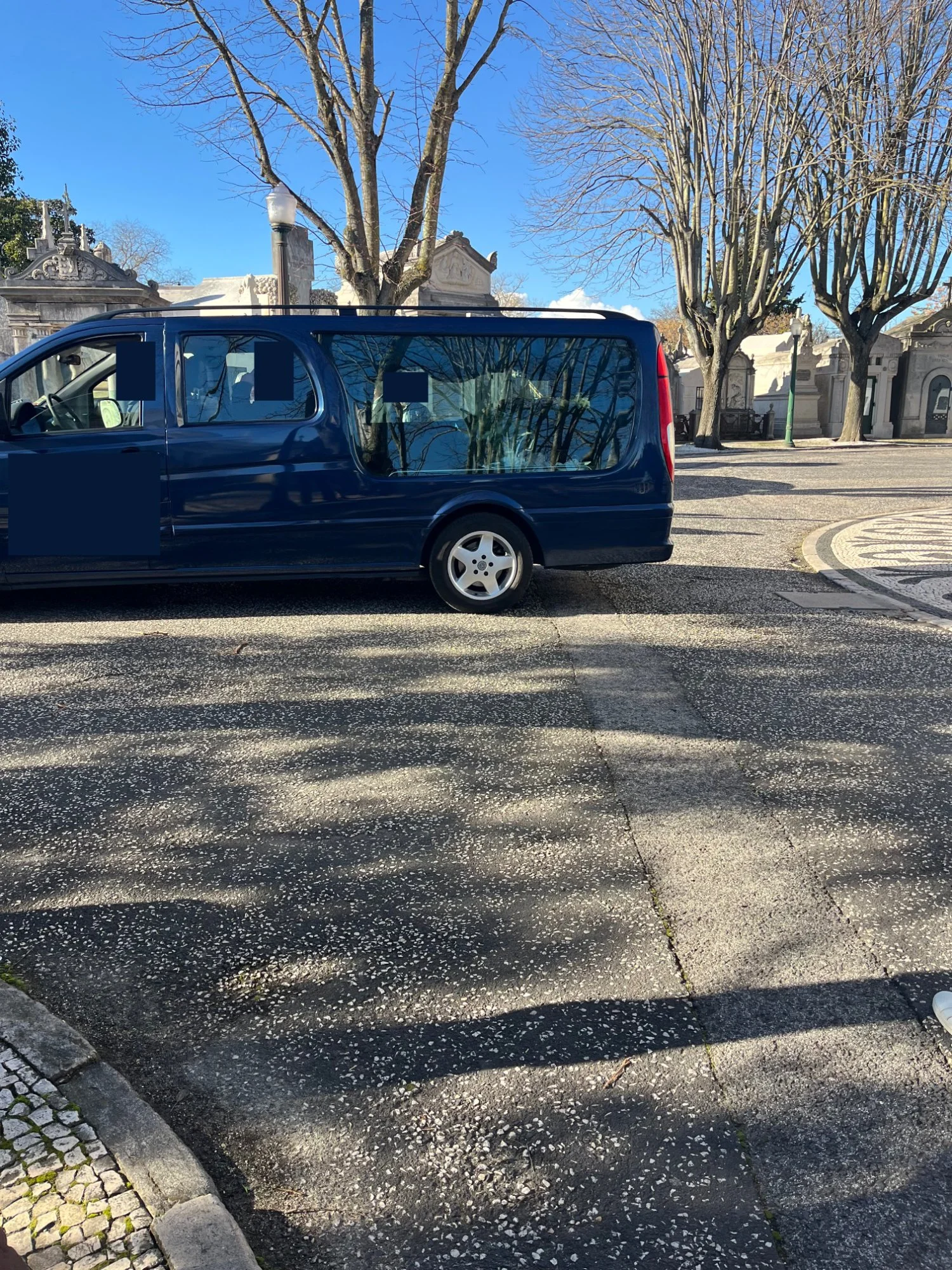
A model of Portuguese hearse
And yet, even here, death remains largely hidden. A suicide can still be erased from public space within three hours. Funerals, like in many places in the west, remain small, quick, intimate affairs, carefully contained. And sometimes I want to ask: Where are your dead, people? Where are they? Where do they pass? Where are they mourned? Where does the city stop for them? Where do the living gather around them?
What happens to a society that no longer walks with its dead? I ask this question genuinely because I believe our relationship to death shapes our relationship to life itself.
A society that hides its dead also slowly loses the capacity to sit with grief, fragility, vulnerability and endings. When death becomes something abnormal, something to quickly remove from sight, something delegated entirely to institutions, professionals, hospitals, funeral homes, we live in societies that also lose the capacity to care.
The dead leave our homes first, then they pass by discreetly in our streets, then they leave our conversations. And eventually, grief itself becomes difficult to hold collectively. People got used to mourn quietly, privately, alone. To return to work and continue functioning.
In many places, even children rarely encounter death directly anymore. They do not see the dead body, they do not witness mourning rituals closely, because maybe there are none. They do not go to cemeteries. They do not watch communities gather around loss. Death becomes abstract, far until it suddenly enters their own lives with unbearable force. And I wonder what this absence is doing to us psychologically, spiritually, and collectively. Because when death disappears from public life, we do not become freer, quite the opposite. We become more frightened, and disconnected from the reality of being alive.
In indigenous way of thinking about death, it is believed that death has functions and some of them are to remind us of impermanence, to remind us of tenderness, to remind us that we belong to one another and that we must care for each other.
What is also striking to me is how much the Western relationship to death is tied to the ideas of civilization, cleanliness, order and control. While death is met with commotion in the global south, the “civilized” body is expected to welcome death calmly, manage grief discreetly. And I often wonder how much of this relationship to death is also colonial. Because colonization has always been deeply concerned with controlling bodies, emotions, rituals, time, and space. It decides which ways of mourning are acceptable and which are considered too much, primitive, irrational, uncivilized, too loud, too emotional.
In many colonized societies, death was not hidden from communal life. Parading the corpse before burial is a common practice. The dead moved through villages, neighborhoods, compounds, streets. Mourning could last days, sometimes weeks. Funeral wouldn’t happen minimum one month after the death. People gathered, sang, cried loudly, cooked, accompanied the dead collectively. As those practices were view as too messy, emotional and public by colonizers, slowly many societies began internalizing these ideas. The more “modern” one became, the more death disappeared from everyday life. But I do not think human beings are built for such distance from mortality. I think something in us needs rituals of encounter. Needs collective witnessing and spaces where loss is acknowledged publicly and not only psychologically endured in isolation.
Death is not an individual event. It rearranges entire relational worlds. And maybe this is part of what I am really asking when I say: Where are your dead?
Maybe through this question I am curious to know Where is your collective memory? where is your relationship to impermanence? Where is your capacity to care? where do the living learn how to accompany endings? where do the dead continue existing among you?… so many questions that are coming to me now, but one last, What kind of society believes maturity means never having to visibly mourn?